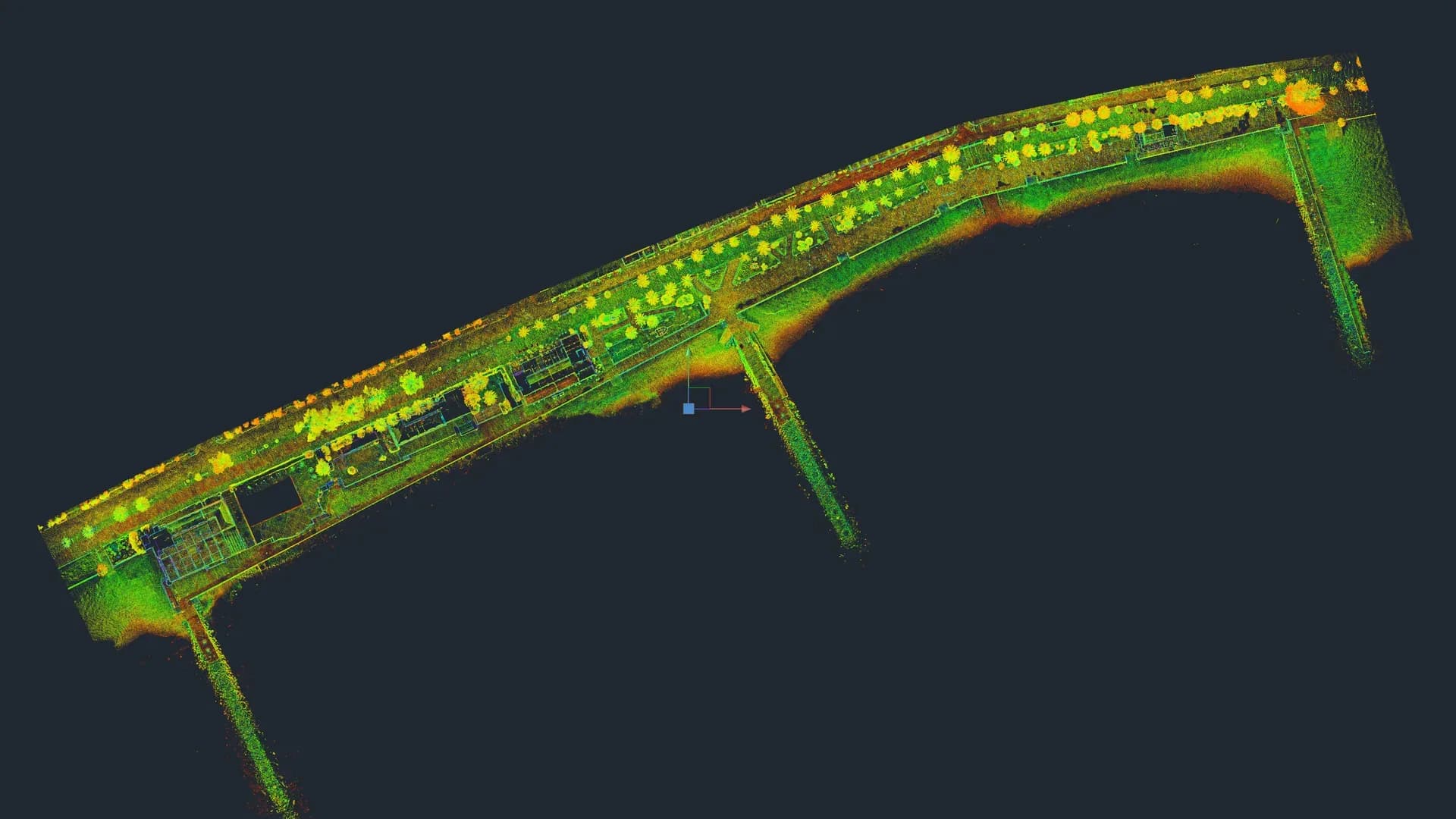
Industrial 3D laser scanning documents the geometry of warehouses, process plants, workshops and logistics centres with millimetric accuracy. On projects where a 5 cm error in a rack or a pipe triggers expensive rework, the TLS point cloud is the only serious method.
A recent case: IDESCO, three warehouses with several floors in the La Maquinista industrial estate (Sant Andreu, Barcelona). They had a fire in part of the facility and needed to renew all the documentation after the intervention: exact position of machines, layout of packaging lines, steel structure and evacuation corridors. Three days of field work plus processing and they were delivered a coherent set of drawings and a model of the three warehouses.
We review the most frequent use cases, the workflow and the real limitations.
What it is used for in industry
1. Extension or refurbishment of existing warehouses
The most common case: a company needs to extend an existing warehouse (mezzanine, offices, production extension) and the original drawings do not match reality after 20-30 years of modifications.
3D scanning delivers:
- Real floor plans with exact dimensions of columns, walls, loading doors.
- Elevations and sections with real clear heights below beams and trusses.
- BIM model (Scan to BIM) to design the extension on verified geometry.
Without this, extension projects drag expensive unforeseen issues from the construction phase.
2. Facility Management and Digital Twin
For large productive or logistics facilities, scanning serves as the basis for the Digital Twin of the building: a BIM model kept updated that enables you to:
- Plan layout changes (racks, production lines) on a real model.
- Document installations (electrical, compressed air, HVAC) for maintenance.
- Prepare documentation for sale or transfer of the industrial asset.
3. Scan to BIM MEP (existing installations)
Mechanical, electrical and plumbing (MEP) installations are the area where Scan to BIM adds the most value in industry. The scan captures:
- Piping for water, gas, compressed air, steam with approximate diameters (measurable on the cloud).
- Cable trays and visible wiring with real dimensions.
- HVAC ducting with exact geometry.
- Steel structure (trusses, lattice beams) with visible connections.
On the cloud, the MEP engineer models the installation in Revit and detects clashes with the new project.
4. Site control in industrial construction
For industrial buildings under construction, periodic scans enable you to:
- Verify that the built structure matches the project.
- Detect column out-of-plumb, beam deviations, manufacturing tolerances.
- Document the as-built before covering installations with false ceilings or enclosures.
It is cheaper to correct a deviation detected in the cloud than to discover it when everything is closed up.
5. Industrial safety and ATEX
In plants with explosive atmospheres (ATEX) or hazardous processes, 3D scanning enables intervention planning and operator training on a digital model, without placing people in risk zones to measure manually.
Real industrial workflow
This is how we typically work on industrial projects:
- Preliminary technical visit (on-site or with drawings provided by the client) to identify accesses, schedules, required PPE, operational restrictions.
- Scan planning by zones: how many stations, where, in what order to minimise occlusions.
- Capture day (1-3 days depending on warehouse): scanning with Trimble X7 from planned station points.
- Registration and cleaning of the cloud: removal of operators, vehicles, mobile objects, dust.
- Delivery: E57/RCP cloud + DWG drawings or BIM model as agreed.
Typical timeline for a 3,000-5,000 m² warehouse: 1-2 field days + 2-3 weeks of processing.
Real limitations (honesty)
Industrial scanning has real limitations:
Occlusions in densely occupied areas
An operating warehouse with full racks, machinery or shelving blocks the laser's line of sight. To achieve full coverage you must:
- Multiply the number of stations (more cost and time).
- Coordinate partial stoppages or clearing of zones.
- Accept that some areas will have lower point density.
Height and accessibility
Industrial roofs at 10-15 m height are difficult to scan well only from the ground. This is combined with:
- Additional station from technical walkways or mezzanines where they exist.
- Spot use of scissor lifts for critical areas.
- Accepting that the skylight or hanging element at 12 m will have less detail.
Reflective and shiny surfaces
Warehouses with polished shiny floors, highly reflective white walls or machinery with polished metal surfaces generate noise in the cloud. This is offset with planning, but you must accept that quality will not match that of a bare-masonry building.
Dusty environments or environments with steam
Plants with a lot of suspended dust, water vapour or fumes affect the laser. Capture windows are planned at suitable times, which may imply working outside productive hours.
Access and safety restrictions
In process plants (chemical, food, energy) there are access protocols, mandatory PPE, safety certificates and permits that can add days of management to the project. It is part of the real budget.
Typical deliverables on industrial projects
| Project | Main deliverable | Typical timeline |
|---|---|---|
| Small warehouse extension | DWG floor plans + elevations | 1-2 weeks |
| Medium logistics warehouse | Cloud + BIM LOD 200 structure | 3-4 weeks |
| Process plant | Cloud + BIM LOD 300 MEP + structure | 6-10 weeks |
| Site control | Periodic cloud with deviation report | Per phase |
| Industrial heritage | Cloud + textured mesh + documentation | 4-6 weeks |
Frequently asked questions
Can you scan while the warehouse is operating? Yes, in most cases. We plan the scan by zones and schedules to minimise interference. On continuous processes (cold chains, 24/7 production lines) we coordinate specific windows.
What accuracy do you guarantee in an industrial environment? The nominal accuracy of the Trimble X7 is ±2 mm at 10 m. In practice, with multiple stations in large warehouses, the relative accuracy between ends may be 5-10 mm. For projects requiring better, we use additional topographic control with GNSS or total station.
Do you work in ATEX environments? Our Trimble X7 equipment is not ATEX certified. In ATEX zones we coordinate with the client on protocols (hot work permits, safety supervisor) and, if impossible, we scan from the perimeter or with access during scheduled shutdowns.
Do you integrate the cloud with industrial software (Autodesk Plant 3D, Aveva)? We deliver the cloud in E57, RCP or LAS, formats compatible with the main plant software. Final integration in Plant 3D or Aveva is done by the client's team or their reference engineering firm.
What budget does an industrial scan require? It varies widely depending on area, complexity, heights and deliverable. For sizing: a medium logistics warehouse (3,000 m²) with DWG floor plans and elevations is in a different range from a process plant with detailed MEP. We quote after a preliminary technical visit.
Do you have a warehouse, plant or industrial facility to document? Tell us the area, current activity and what you need to deliver. We will give you a realistic timeline and quote with no commitment. Talk to us.
Cover image: Axisadman · Wikimedia Commons · CC BY-SA 3.0
← Back to blog