The ITE (Spanish Mandatory Building Inspection, Inspección Técnica de Edificios) is a compulsory check that certifies the condition of a building. In Catalonia it is regulated by Decret 67/2015, which requires an ITE on residential buildings more than 45 years old. Non-compliance is sanctioned with fines of between €9,000 and €90,000.
Transparency: what we offer is the step before the inspection: providing the technician (architect or building engineer) with accurate geometric documentation (plans, elevations, point cloud) so their inspection is faster, more complete and has a verifiable documentary basis. It is a service we have designed and have operational for technicians and public administrations; specific ITE case studies of our own are being accumulated now.
In this article we explain what an ITE covers, which prior documentation helps the technician and how 3D laser scanning helps to tackle the inspection with verifiable data rather than visual estimates.
What an ITE covers
An ITE analyses 4 main blocks of the building:
- Structure: foundations, columns, beams, slabs, stairs.
- Envelope: facades, party walls, roof, exterior joinery.
- Common services: downpipes, drainage, water mains, gas, electricity (visible parts).
- Elements that may affect the public way: cornices, overhangs, ornamental elements.
The technician issues a report classifying each deficiency as minor, important, serious or very serious, and proposes actions. The report is submitted to the relevant authority.
What prior documentation the technician needs
Before the inspection, the technician benefits from having:
- Updated plans and sections of the building.
- Facade elevations with real dimensions.
- External volumetry to identify overhangs and at-risk elements.
- Photographs with geometric reference to document defects.
In older buildings, these documents rarely exist or are out of date. That is where 3D laser scanning comes in.
What 3D scanning brings to an ITE
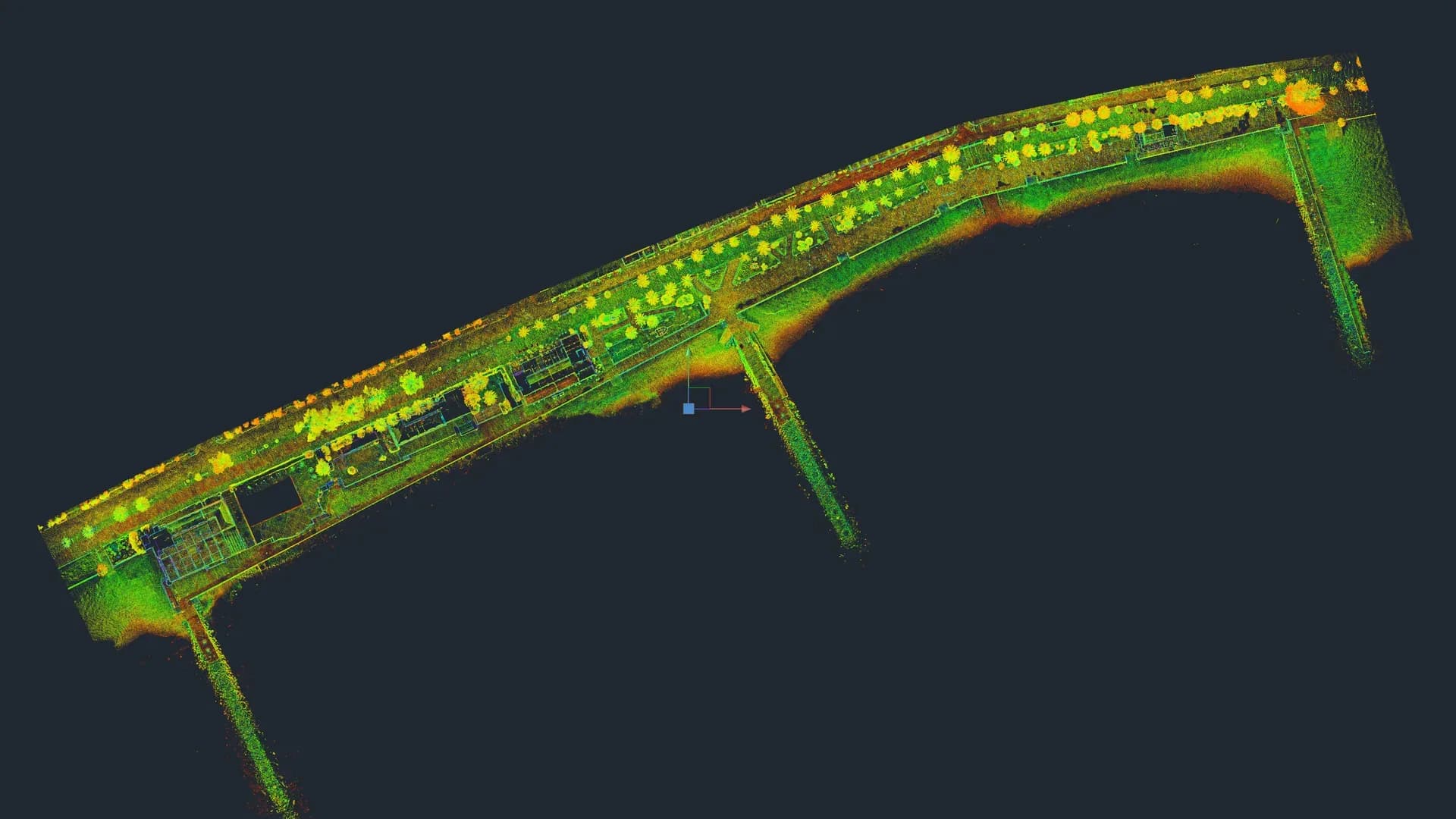
A 3D laser scan of the building delivers the following to the technician:
1. Real plans and elevations in hours
In one morning on site, facades, accessible roofs and common areas are scanned. Within 2-3 working days, the technician receives plans and elevations in DWG with real dimensions and millimetre detail.
Compared with traditional manual measurement (which may require scaffolding or a telescopic pole to measure heights), it is much faster and more accurate.
2. Detection of deformations and out-of-plumb conditions
The point cloud reveals deformations and out-of-plumb conditions impossible to spot by eye. A 2 cm out-of-plumb on a 3 m column is clearly visible in the cloud and can be measured directly. This information is key to correctly classifying the severity of a structural defect.
3. Facade analysis without scaffolding
The scanner captures complete facades from the public way or from accessible elevated positions (neighbouring terraces, courtyards). The cloud allows you to identify:
- Active cracks and their orientation.
- Facade out-of-plumb.
- At-risk ornamental elements (loose cornices, deformed railings).
- Damp stains with exact geometric reference.
It does not replace the technician's visual inspection (which is mandatory and required in any case), but it prepares the work and makes it possible to prioritise which areas require close physical inspection.
4. Documentation for future action
If the ITE detects important or serious deficiencies, the owner will have to refurbish. The point cloud and scan drawings are already done: they feed directly into the subsequent refurbishment project, with no need to re-measure.
This is cumulative value: one scan covers the ITE, the refurbishment project and, if needed, project handover (final As-Built).
Full workflow: ITE with prior documentation from 3D scanning
This is how we typically work with technicians commissioning an ITE:
- Initial call (15 min) to understand the building, age, suspected defects and access.
- Field visit (half a day to one day depending on size) with a Trimble X7 scanner. Covers facades, roof, internal courtyard, common areas, stairwells.
- Processing and delivery (2-5 working days): plans, elevations, sections and point cloud.
- The technician carries out the inspection with the documentation in hand.
- Technical consultation with the owner using objective data in the report.
For a multi-family residential building of 4 floors and 500-700 m² built area, the total lead time from call to delivery of documentation is between 5 and 10 days.
What scanning does NOT replace
It is worth being clear about what scanning does not do so that expectations are aligned:
- It does not detect hidden defects (interior wall damp, rebar corrosion inside concrete, termites in timber). That requires cores, tests and the technician's experience.
- It does not measure material thickness or quality. The cloud sees what is visible.
- It does not replace close physical inspection of critical elements.
What it does is give you the best possible geometric baseline so that the technician works faster and more safely, and so that the documentation filed with the authority is rigorous.
Indicative cost
It depends on the building and the deliverable. As an order of magnitude for Barcelona and Catalonia:
- Small multi-family building (3 floors, 400 m²): scan + base DWG → project-specific quote.
- Medium multi-family building (5-6 floors, 800-1,200 m²): rises with height and roof access.
- Buildings with communal courtyard or restricted access: a prior visit is assessed to quote.
We do not publish fixed rates because the relevant factors (accessibility, schedule, occupied building, deliverable) vary widely. Quote within 24 h after a brief call.
Frequently asked questions
Can you scan the building without notifying neighbours? Common areas and facades, yes. The interior of dwellings requires coordination with the owners (usually not scanned during ITE unless specifically requested).
Can it be scanned from the street? Facades accessible from the public way, yes. Roofs require access; we coordinate that with the property.
Do you work with property managers? Yes. Typically the manager engages the ITE technician and the technician subcontracts the survey to us. We can invoice the technician or the manager directly.
Do you cover Barcelona and the rest of Catalonia? Yes. Barcelona, Girona, Tarragona, Lleida and the rest of Spain subject to travel assessment.
Are you a technician looking for precise documentation before your next ITE? Are you a property manager needing to scan a building to submit an ITE to the council? Tell us about the case. Let us talk.
Cover image: Zarateman · Wikimedia Commons · CC0
← Back to blog