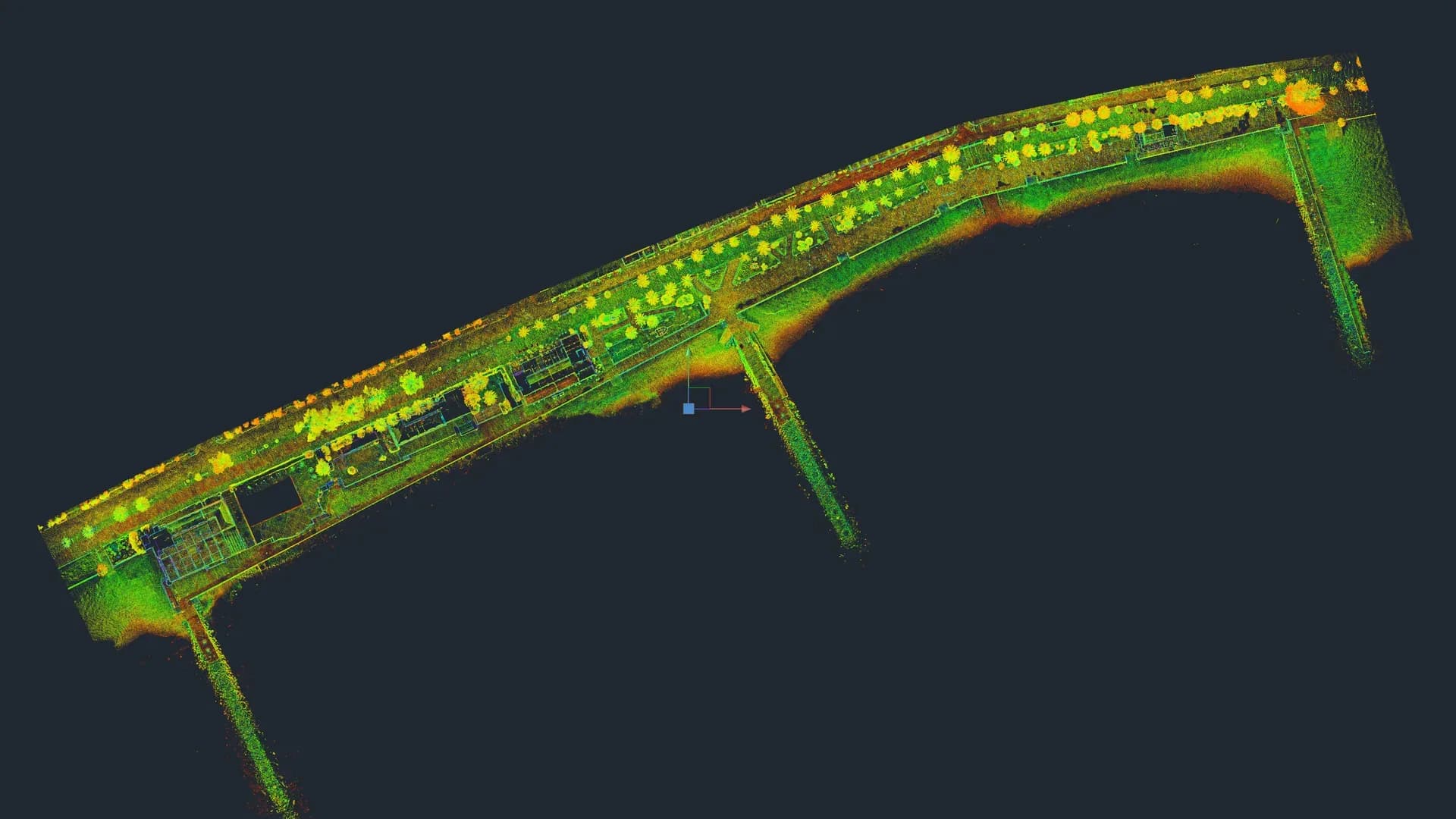
Every time we set up the Trimble X7 on its tripod, it fires a million points per second against walls, ceilings, facades and details. 3-5 minutes per station. To document 600 metres of the Sitges seafront promenade it took us dozens of linked stations; to cover the whole Portal de l'Àngel from Plaça Catalunya to the Cathedral it was the same. The laser picks up cornices, balconies, street lamps and railings with a level of detail that is simply unfeasible to capture by hand.
That set of millions of points is called a point cloud, and it is the raw material from which DWG drawings, BIM models, volume calculations and documentation for refurbishment or ITE (Spanish Mandatory Building Inspection) are produced.
How a 3D laser scanner works
A terrestrial laser scanner works on a simple principle: it emits a laser beam, measures the time it takes to bounce off a surface and return, and uses that time to calculate the exact distance to that point. By repeating this operation millions of times per second in every direction, it reconstructs the space in three dimensions.
At Registra3D we work with a Trimble X7, a professional 3D laser scanner with the following characteristics:
- 2 mm accuracy at 10 m distance (point noise)
- Useful range up to 80 m per station
- 4 mm resolution between points at 10 m
- Integrated 360° HDR camera that adds true colour to the cloud
- Auto-calibration and self-levelling with no need for targets
Each scan station generates a 3D point cloud with millions of points. Later, in the office, those stations are registered (merged) into a single coherent model of the full building or site.
What you get: from the point cloud to the deliverables
The raw point cloud is useful, but almost no end client consumes it directly. The standard practice is to transform it into specific deliverables for each discipline:
- 2D drawings in DWG: plans, elevations and sections of the current state, directly usable in AutoCAD.
- Parametric BIM models: geometry in Revit or Archicad at LOD 200 to 350, ready to develop the new project on top of the existing one.
- Digital Terrain Models (DTM): contour lines, triangulated meshes, volume calculations.
- Web 3D viewers: browser-navigable links, no special software, to share with the client or the team.
- Textured 3D meshes: OBJ format for interior design, heritage or virtual reality.
The step from cloud to deliverable is manual, requires technical judgement and is where most of the value of a provider like Registra3D materialises. Scanning is the raw material; the deliverables are the product.
What 3D laser scanning is used for
3D scanning adds value when any of these conditions are met: the project needs real accuracy of the existing state, there is complex geometry, deadlines are very tight, or the cost of an error on site is high. These are the most frequent uses in our day-to-day work:
Architecture and refurbishment
When an architect is going to refurbish a building, change its use or carry out a remodelling, they need to start from the real current state, not from the original drawings (which almost never match). A 3D scan delivers exact plans, elevations and sections in just a few days.
This is the core use of our 3D scanning for architecture and refurbishment services.
As-Built survey
When a construction project finishes and it becomes necessary to document what has actually been built (which almost always differs from the project), 3D laser scanning delivers a measurable and verifiable As-Built instead of an estimate. Very useful for project handover, Facility Management or contractual documentation.
We cover this in As-Built survey with 3D scanner.
Civil engineering and topography
Roads, tunnels, bridges, slopes, industrial structures, roofs. 3D laser scanning covers large surfaces in hours, with accuracy impossible to reach on foot. It integrates with GNSS systems to georeference the model in official coordinates.
More detail in civil engineering and topography.
Heritage and archaeology
Churches, castles, ruins, cultural heritage assets. 3D scanning is non-invasive, captures ornaments and irregular geometries with a level of detail impossible to draw by hand, and leaves a permanent digital twin of the asset.
Industry and logistics warehouses
Existing facilities, pipework, steel structures, racking. Useful to plan expansions, detect clashes with new equipment or document the state of industrial assets.
Precision interior design
Interior scanning for custom furniture design. Where millimetre fit matters (kitchens, built-in wardrobes, curved partitions), scanning avoids repeat visits and pieces that do not fit.
Advantages over traditional measurement
| Aspect | Manual measurement | 3D laser scanning |
|---|---|---|
| Information density | Singular points | Full cloud (millions of points) |
| Accuracy at 10 m | ±1-2 cm typical | ±2 mm (Trimble X7) |
| On-site time | Hours or days | Minutes per station |
| Verifiable afterwards | No (only notes) | Yes (the cloud stays on record) |
| Complex geometry | Very difficult | Automatic capture |
Scanning does not replace the designer's technical judgement: it frees them from the mechanical part of measuring so they can focus on the project.
When it is NOT the best option
3D laser scanning is not always the right tool. These are the cases where other methods make more sense:
- Very small jobs (a single room, a 40 m² shop) where a laser distance meter and half a day of an architect's time are faster.
- Projects without a need for real accuracy (for example, a preliminary feasibility study with photos and approximate measurements is enough).
- Interiors with many untreated reflective or transparent surfaces (glass, large mirrors): the laser has real limitations there and you have to compensate with more stations or prior preparation.
At Registra3D we say when scanning is not worth it. We prefer not to invoice a job that does not add value over doing it and losing the client's trust.
And the price? It depends on 3 factors
The cost of a 3D laser scan depends on:
- Surface and number of stations: a 120 m² apartment is not the same as a 3,000 m² warehouse.
- Final deliverable: an unprocessed point cloud costs far less than a full LOD 350 BIM model.
- Accessibility: heights, active construction, restricted schedules multiply field time.
That is why we do not publish fixed rates: each project is quoted on its own merits after a call or site visit. We commit to responding in less than 24 h.
Frequently asked questions
How long does a scan take? For an average residential building, between half a day and two days on site. Deliverables (DWG, BIM) are delivered 5 to 15 working days afterwards, depending on scope.
Do you need the building to be empty? No. The Trimble X7 captures what it sees; in occupied buildings, stations are planned to avoid areas with movement.
Do you work outside Barcelona? Yes. Our base is in Barcelona (Sant Gervasi), but we cover all of Catalonia, Spain and international projects subject to availability.
Do you deliver the point cloud as well as the drawings? Yes. By default we deliver cloud + the agreed deliverable (DWG, BIM…). The cloud is archived and we can generate new deliverables from it in the future without repeating the scan.
If you are considering a 3D scan for a specific project, tell us what you need and within 24 h we will tell you whether scanning is the best option, how much it would cost and what you would deliver to your client. Request a quote with no commitment.
Cover image: Best Tech Nick 25 · Wikimedia Commons · CC0
← Back to blog